NewsHail
25 May 2025
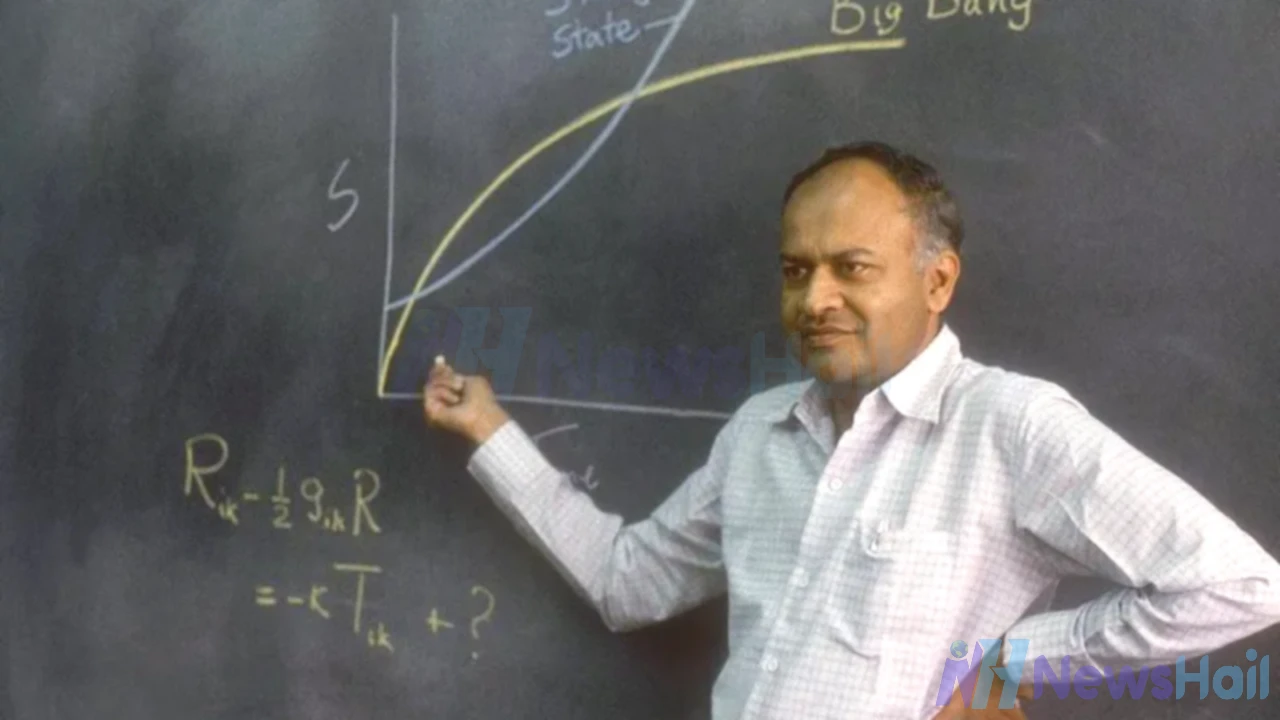
In a science fiction story from 1983, Indian astrophysicist Jayant Narlikar imagined what schools would look like in 2050. He pictured an alien student sitting in front of a screen, attending online classes. While aliens have not shown up yet, online learning became real in 2020 during the Covid-19 pandemic.
Narlikar also had bold ideas about how the universe began. Many people believe in the Big Bang Theory, which says the universe started at one point in time. But Narlikar thought the universe had no beginning. He believed it had always been there, growing forever.
Narlikar passed away on Tuesday at the age of 86. He was one of India's greatest scientists. He helped guide many young researchers and promoted science education.
His funeral drew a large crowd—school kids, top scientists, and even his housekeeping staff. This showed how many lives he touched.
Narlikar was born on 19 July 1938 in Kolhapur, a town in the Indian state of Maharashtra. His home was full of books and learning. His father was a math professor, and his mother was a Sanskrit scholar.
He followed in their footsteps and went to Cambridge University in the UK. There, he was a top student in math and also studied the stars and space.
The most important part of his time at Cambridge was meeting his guide, Sir Fred Hoyle. Together, they created a new idea about how the universe works. This idea challenged the Big Bang Theory.
They said the universe is infinite and always growing. New matter keeps appearing. This was called the quasi-steady state model.
In his life story, My Tale of Four Cities, Narlikar used a simple example to explain it. He said it’s like putting money in a bank. The interest keeps growing, and the total amount grows too. Just like that, the universe keeps growing.
Famous astronomer Somak Raychaudhury says Narlikar’s theory is still helpful. He added, “Even if the Big Bang became more popular, Narlikar’s ideas still help scientists today.”
Even when Hoyle started to accept the Big Bang, Narlikar stayed loyal to his own theory. A sign outside his office read: “The Big Bang is an exploding myth.”
Narlikar stayed in the UK until 1971. He worked at King’s College and helped start the Institute of Theoretical Astronomy.
As he became well-known worldwide, India took notice. In 1972, he came back to India. He led the Theoretical Astrophysics Group at the Tata Institute of Fundamental Research until 1989.
But his biggest gift to India was starting a new science center.
In 1988, he helped create the Inter-University Centre for Astronomy and Astrophysics (IUCAA) in Pune, Maharashtra. It started in a tiny room but became a world-class place for space science.
Narlikar was its first director until 2003, and stayed on as a professor after that.
He wanted science to reach everyone—not just scientists. IUCAA began hosting lectures, science camps, and workshops for school kids and the public.
Science educator Arvind Gupta remembers his words: “PhD students don’t fall from the sky. You must find them young.” Narlikar invited him to run the center for kids. What started as a six-month plan became 11 years. “He gave me wings to fly,” said Gupta.
Narlikar wrote over 300 research papers, but he didn’t stop there. He also wrote science fiction books based on real science. These stories were translated into many languages.
In one story called “Virus” (2015), he imagined a global pandemic. In his 1986 book Waman Parat Na Ala (The Return of Vaman), he wrote about AI and ethics.
Sanjeev Dhurandhar, part of the Indian team that found gravitational waves in 2015, shared a story. Early in his career, Narlikar gave him a tough problem. After he struggled for a week, Narlikar solved it in 15 minutes. But he did it to teach, not show off. He also supported new ideas, like gravitational waves, and gave others the courage to try them.
Narlikar was also a rational thinker. In 2008, he wrote a paper using math to question astrology. Raychaudhury said Narlikar’s goal was always to question things that had no scientific proof.
But when it came to real science, Narlikar was open to even the tiniest chances.
Even in his last days, he stayed active—answering letters from kids and writing about science on his blog.